

 Himadri
Crypto and cryptocurrency have captured the imagination of millions of investors around the globe. Previously, we explored how blockchain technology works in our earlier TechaDigi blockchain guide. Now, we will dive deeper into the real-world mechanics, market structure, risk management strategies, and legal framework of crypto trading in India so you can navigate the digital asset space with confidence.
If you are thinking about taking your first steps into the crypto market in 2026, it is vital to cut through the social media noise. Sustainable success in this space never comes from blind luck, meme-coin hype, or chasing overnight riches; it comes from structured financial education, emotional patience, and a disciplined execution strategy. In this comprehensive guide, we break down the essentials of cryptocurrency trading, contrast smart long-term investing against high-risk derivatives speculation, explain India’s tax and compliance regulations, and show you how to get started safely.
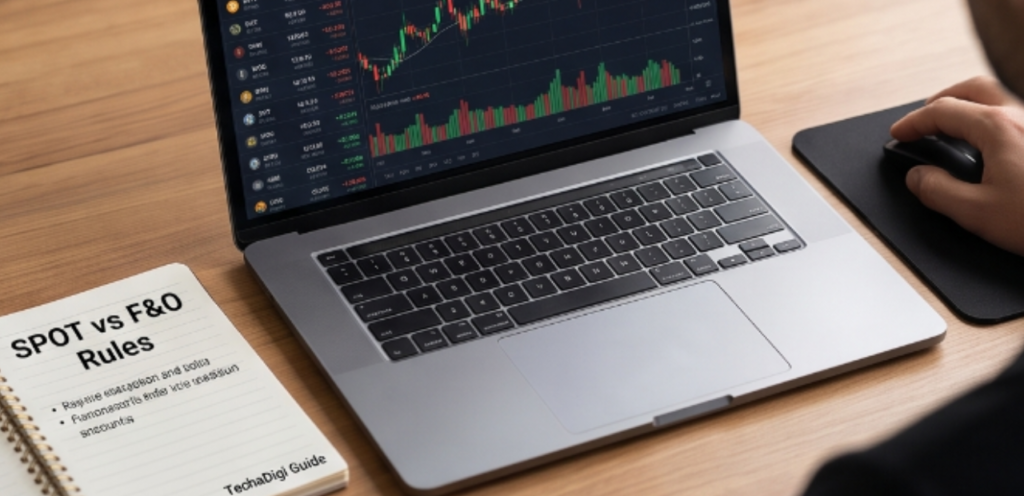
Understanding the Foundation: What Is Crypto and How Does the Market Work?
What started as a niche cypherpunk experiment over a decade and a half ago with the launch of Bitcoin in 2009 has now evolved into a multi-trillion-dollar, globally recognized asset class. Institutional asset managers, sovereign funds, and everyday retail participants now view digital assets as a permanent fixture of the modern financial system. Yet for anyone sitting on the sidelines, the world of crypto can feel both exhilarating and overwhelming. Financial headlines regularly spotlight massive triple-digit gains, while regulatory advisories warn newcomers about severe price volatility.
At its core, a cryptocurrency is a form of digital or virtual asset that uses advanced mathematical cryptography for transaction security, making it virtually impossible to counterfeit or double-spend. Unlike traditional government-issued fiat currencies—such as the Indian Rupee (INR), the US Dollar (USD), or the Euro (EUR)—most cryptocurrencies operate without a central bank or single administrator. Instead, they run on a decentralized peer-to-peer network known as a blockchain, which acts as a transparent, immutable distributed ledger maintained by thousands of independent computers (nodes) worldwide.
Major Categories of Digital Assets You Need to Know
When beginners hear people talk about the crypto market, they usually think of a single type of coin. In reality, the modern digital asset ecosystem is divided into distinct functional categories, each carrying its own risk profile and real-world utility:
- Bitcoin (BTC) – Digital Gold and Store of Value: As the first and largest cryptocurrency by market capitalization, Bitcoin was engineered with a strictly capped supply of 21 million coins. Investors worldwide treat BTC primarily as a decentralized store of value and an algorithmic hedge against long-term fiat currency inflation.
- Ethereum (ETH) and Smart Contract Platforms (Layer-1 Networks): Networks like Ethereum, Solana (SOL), Avalanche, and Cardano go beyond simple peer-to-peer payments. They function as programmable decentralized supercomputers capable of executing self-enforcing code called smart contracts, which power decentralized finance (DeFi) protocols and decentralized applications (dApps).
- Layer-2 Scaling Solutions: Built on top of foundational blockchains like Ethereum, Layer-2 networks (such as Polygon, Arbitrum, and Optimism) process transactions off the main chain at high speeds and low fees before bundling and settling the cryptographic proofs back onto Layer-1.
- Stablecoins (USDT, USDC): Because standard cryptocurrencies fluctuate in price every second, traders use stablecoins—digital tokens whose value is pegged 1:1 to a stable reserve asset like the US Dollar—to park capital safely between trades without exiting the blockchain ecosystem.
- Utility Tokens and Altcoins: Any digital asset other than Bitcoin is broadly referred to as an alternative coin, or “altcoin.” While many utility tokens grant access to specific blockchain services, cloud storage networks, or decentralized AI compute platforms, thousands of low-cap altcoins lack real-world adoption and carry significantly higher downside risk.
Why Do Crypto Prices Fluctuate 24/7?
Unlike traditional stock markets like the National Stock Exchange (NSE) or Bombay Stock Exchange (BSE), which operate only during fixed daytime business hours Monday through Friday, the global crypto market never sleeps. Digital assets trade 24 hours a day, 7 days a week, 365 days a year across global liquidity pools.
Prices move continuously based on an interplay of real-time supply and demand, macroeconomic interest rate decisions, institutional exchange-traded fund (ETF) inflows, technological upgrades, tokenomics schedules (such as Bitcoin’s quadrennial halving cycle), and overall market sentiment. Understanding that a 10% to 20% price correction is routine in cryptocurrency markets prepares you mentally so you never panic-sell during normal market pullbacks.
Investment vs. Speculation: Choosing Your Path in the Crypto Market
Before you deposit a single rupee into an exchange or execute your first order, you must answer one fundamental question honestly: What is your financial goal, and what is your true risk tolerance?
The single biggest mistake new market participants make is confusing patient capital allocation with high-frequency gambling. Broadly speaking, there are two distinct ways retail participants interact with the market: Long-Term Spot Investing and Futures & Options (F&O) Derivatives Trading.
1. Long-Term Spot Investing (The Smart Beginner’s Blueprint)
For the overwhelming majority of beginners, long-term spot investing is the safest, calmest, and most proven entry point into digital assets.
- How Spot Investing Works: In the spot market, you purchase actual units of a cryptocurrency (such as Bitcoin or Ethereum) using your own cash for immediate delivery and settlement. You hold those assets in your exchange portfolio or private wallet over months or years, allowing their value to compound as global network adoption matures.
- Why Spot Investing Fits Beginners: Your maximum financial downside is strictly capped at the exact amount of capital you invest. There are no margin calls, no complex expiration dates, no borrowed leverage fees eating away at your balance overnight, and no anxiety from minute-to-minute chart fluctuations. If the market experiences a temporary downturn, you still own the exact same number of coins and can wait patiently for the macro cycle to recover.
- The Power of Rupee Cost Averaging (SIP in Crypto): Rather than trying to guess the exact bottom of the market with a single lump-sum purchase, experienced investors use systematic Rupee Cost Averaging (RCA). By investing a fixed, affordable amount (for example, ₹1,000 or ₹2,500 every week or month) into battle-tested assets regardless of short-term price noise, you automatically buy more units when prices are low and fewer units when prices are high, lowering your average entry cost over time.
2. Futures and Options (F&O) Derivatives Trading
On the opposite end of the risk spectrum sits advanced derivatives trading, primarily perpetual futures and options contracts.
- How Derivatives Trading Works: Instead of buying the underlying cryptocurrency asset itself, traders enter financial contracts that speculate on short-term price direction. Using borrowed exchange funds—known as leverage (such as 5x, 10x, or even 50x)—a trader can control a ₹50,000 position with just ₹1,000 of their own margin capital, betting on whether the market will rise (going Long) or fall (going Short) within hours or days.
- Why Beginners Should Strictly Avoid High-Leverage F&O: While the promise of amplified returns attracts inexperienced newcomers, leverage is a double-edged sword. At 10x leverage, a mere 10% move against your position triggers an automatic forced liquidation, wiping out 100% of your margin capital instantly. Global financial regulators repeatedly emphasize that the vast majority of retail traders lose money in leveraged derivatives because algorithmic trading desks and sudden liquidity wicks hunt over-leveraged retail stop-losses.
Spot Investing vs. Futures & Options: Side-by-Side Comparison
| Feature | Spot Investing | Futures & Options (F&O) Trading |
|---|---|---|
| Asset Ownership | You own the actual crypto asset directly | You hold a speculative price contract |
| Use of Leverage (Borrowed Money) | None (1x cash basis only) | High (typically 2x to 50x+) |
| Liquidation Risk | Zero (you cannot be forcibly liquidated) | Extreme (small adverse swings wipe out capital) |
| Time Commitment | Low (weekly or monthly portfolio check-ins) | Very High (constant chart & margin monitoring) |
| Recommended For | Beginners & long-term wealth builders | Experienced institutional & quantitative traders |
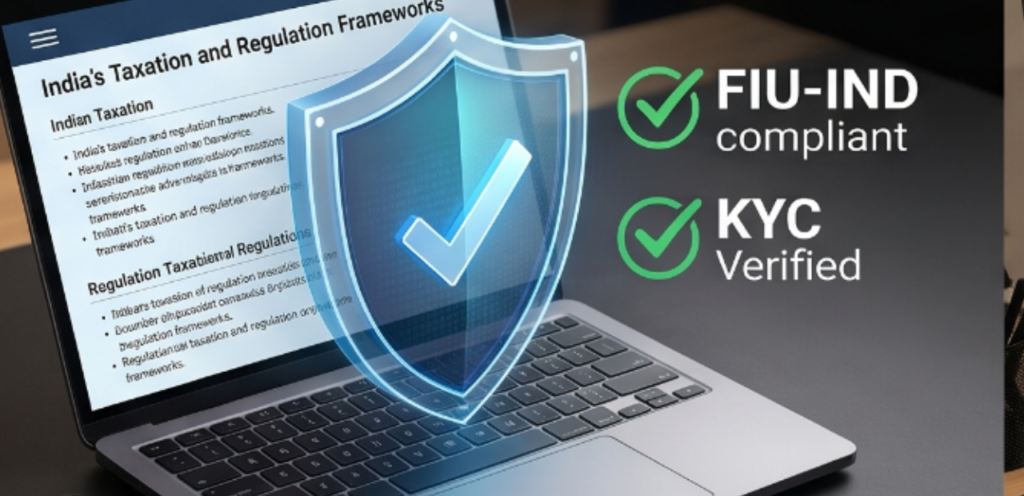
Legality, Regulation, and Taxation of Crypto Trading in India (2026 Guide)
One of the most common questions Indian beginners ask is: “Is cryptocurrency trading legal in India?” The short answer is yes. Buying, selling, holding, and trading Virtual Digital Assets (VDAs) is completely legal in India, provided you trade through compliant, government-registered platforms and fulfill your statutory income tax obligations.
While cryptocurrencies are not classified as legal tender (meaning only the Reserve Bank of India’s physical Rupee and Digital Rupee/e₹ serve as official sovereign currency for everyday commerce), the Government of India actively regulates and taxes cryptocurrencies as **Virtual Digital Assets (VDAs)** under the Income Tax Act.
1. Mandatory FIU-IND Registration and AML Compliance
Under the Prevention of Money Laundering Act (PMLA), the Ministry of Finance requires all Virtual Digital Asset service providers operating in India to register with the Financial Intelligence Unit – India (FIU-IND). Unregistered offshore exchanges that refuse to comply with Indian anti-money laundering standards face URL blocking and banking restrictions.
When you choose an FIU-IND registered Indian exchange, the platform enforces strict Know Your Customer (KYC) verification (linking your PAN card, Aadhaar, and verified bank account). This compliance shield protects your account against illicit peer-to-peer (P2P) fraud—which frequently causes sudden bank account freezes when traders unknowingly accept tainted funds on unregulated P2P boards—and guarantees clean, auditable INR deposits and withdrawals.
2. Understanding India’s 30% VDA Tax and 1% TDS Framework
Every smart Indian investor calculates post-tax net returns before placing a trade. Under Section 115BBH and Section 194S of the Indian Income Tax Act, Virtual Digital Assets are governed by three clear rules:
- Flat 30% Tax on Profits: Any positive capital gain realized from selling, swapping, or trading a cryptocurrency is taxed at a flat rate of 30% (plus applicable surcharge and 4% health and education cess), regardless of your personal income tax slab or whether you held the asset for one day or five years.
- 1% Tax Deducted at Source (TDS): Whenever you sell a digital asset above the statutory annual threshold, a 1% TDS is deducted on the transaction value. When you trade on a compliant Indian exchange like CoinDCX, the platform automatically calculates, deducts, and deposits this 1% TDS against your PAN card, so it shows up effortlessly in your Form 26AS and Annual Information Statement (AIS) during tax season—and can be claimed as credit against your total tax liability.
- No Set-Off of Losses Across Assets: Under current VDA tax rules, a loss incurred on one digital asset cannot be used to offset a profit made on another digital asset, nor can losses be carried forward to future financial years. Only the direct cost of acquisition (purchase price) is deductible. This tax reality is another powerful reason why disciplined, high-conviction spot investing beats reckless day trading across dozens of speculative tokens.
5 Essential Golden Rules for Safe Crypto Investing and Risk Management
If you want to build a resilient, stress-free journey in the crypto ecosystem without falling victim to market traps, anchor your strategy around these five time-tested rules:
Rule 1: Only Invest Capital You Can Afford to Hold Long-Term
Digital asset markets remain highly cyclical. Sudden regulatory announcements, macroeconomic shifts, or geopolitical headlines can trigger sharp double-digit swings within 24 hours. Never invest your emergency medical fund, house rent, borrowed credit card funds, or money earmarked for upcoming family milestones into volatile markets. When you invest strictly disposable capital, you gain the emotional superpower to hold calmly through deep market downturns without being forced to sell at a loss.
Rule 2: Prioritize FIU-IND Registered Platforms and Account Security
Always execute your trades on established exchanges registered with the Financial Intelligence Unit (FIU-IND). Beyond regulatory compliance, fortify your personal account hygiene on day one: enable hardware or app-based Two-Factor Authentication (2FA) (such as Google Authenticator rather than SMS alone), set up anti-phishing email codes, whitelist your withdrawal addresses, and never share your OTPs or seed phrases with anyone claiming to be customer support on Telegram or X.
Rule 3: Focus on Fundamental Education Over Social Media Hype
Never buy a token simply because an influencer posted rocket emojis or because a chart already pumped 300% in two days. By the time a speculative meme token trends on social media, early insiders are actively looking for retail buyers to use as exit liquidity. Take the time to evaluate a project’s real-world problem-solving utility, active developer ecosystem, circulating vs. unlocked token supply, and daily trading liquidity before committing capital.
Rule 4: Practice Smart Portfolio Allocation (The Core-Satellite Approach)
Seasoned portfolio managers rarely put 100% of their digital asset capital into unproven micro-cap coins. Instead, many use a Core-Satellite strategy: allocating 70% to 85% of their portfolio into battle-tested foundational assets with deep institutional liquidity (such as Bitcoin and Ethereum), while reserving no more than 15% to 30% for thoroughly researched large-cap utility networks. This structure captures market upside while shielding your portfolio against single-project failures.
Rule 5: Master Your Emotions Against FOMO and FUD
Two emotional forces destroy more retail portfolios than any technical bug: FOMO (Fear Of Missing Out, which tricks beginners into buying at the very top of a euphoric green candle) and FUD (Fear, Uncertainty, and Doubt, which scares beginners into panic-selling at the exact bottom of a red crash). Write down your entry budget, target holding horizon, and profit-taking milestones before you buy, and stick to your written plan automatically.
Common Beginner Mistakes to Avoid in Your First Year
Even intelligent professionals lose money when they enter the cryptocurrency market without knowing the hidden pitfalls that trap first-time buyers. Keep a close watch out for these four common errors:
- Falling for Direct P2P Scams and Bank Freezes: Trying to save a small fraction in fees by trading directly with strangers in unverified peer-to-peer Telegram groups or unregulated P2P boards can connect your bank account to cybercrime proceeds, leading to cyber-cell lien holds. Always deposit and withdraw INR through direct, verified banking channels on an FIU-registered exchange.
- Revenge Trading After a Small Loss: If a short-term trade moves against you, never double your position size or add leverage to “win back” the money immediately. Emotional revenge trading is the fastest path to account depletion.
- Ignoring Trading Fees and Tax Overheads: Over-trading ten times a day racks up maker/taker exchange fees, bid-ask slippage, and repeated 1% TDS deductions that silently erode your principal even when your win rate looks decent on paper.
- Clicking Fake Airdrop and Phishing Links: Never connect a Web3 wallet to random “free reward claim” links sent via social media DMs. Malicious smart contract approvals can drain connected wallets in seconds.
Taking Your First Step: How to Start Investing Safely Today
Starting your crypto journey does not have to be intimidating or complicated. The formula for a confident start is simple: begin with a small amount of capital, stick to transparent spot investing, automate your learning, and choose a legally compliant Indian platform that handles security and tax reporting seamlessly.
If you are ready to make your first move on a trusted, FIU-IND registered exchange built specifically for Indian investors, you can explore CoinDCX. CoinDCX provides a clean, beginner-friendly interface for spot investing, automated systematic investment plans (CIP), transparent fee structures, and automated TDS reporting so you never have to worry about compliance headaches.
Plus, if you are setting up your account right now, CoinDCX is running an ongoing promotional campaign where new and active participants can earn rewards while learning the ropes:
Limited time: ₹10L worth of BTC rewards up for grabs! Trade Spot or Futures on CoinDCX and win assured Bitcoin rewards worth up to ₹10L. 🚀
Tap here to get started on CoinDCX
Let’s make your first step the right one! 🚀
Frequently Asked Questions (FAQ) About Crypto Trading in India
1. How much minimum money do I need to start crypto investing in India?
You do not need thousands of rupees to buy a whole Bitcoin. Because cryptocurrencies are divisible up to eight decimal places (where 1 Bitcoin equals 100,000,000 Satoshis), you can start buying fractional units of Bitcoin or Ethereum on Indian exchanges like CoinDCX with as little as ₹100 to ₹500.
2. Is cryptocurrency legal in India in 2026?
Yes. Investing in and trading Virtual Digital Assets (VDAs) is completely legal in India. To stay 100% compliant with Indian law, always trade on platforms registered with the Financial Intelligence Unit (FIU-IND), complete full PAN and Aadhaar KYC verification, and report your VDA gains under Schedule VDA when filing your annual Income Tax Return (ITR).
3. Why is Spot Investing recommended over Futures trading for beginners?
Spot investing gives you direct ownership of the underlying digital asset without borrowed money, meaning your position can never be forcibly liquidated during temporary market dips. Futures trading relies on borrowed leverage, where a brief price swing against your direction can wipe out your entire margin balance in minutes.
Final Thoughts
Crypto and blockchain technology represent one of the most transformative financial and technological frontiers of our generation, but navigating these markets successfully requires patience, realistic expectations, and a level head. By focusing on long-term spot investing, respecting your personal risk limits, choosing FIU-IND compliant exchanges, and educating yourself continuously, you can participate in the digital asset revolution safely and responsibly.

Informative. But still not understand why people make lose?? No strategy is 100%