
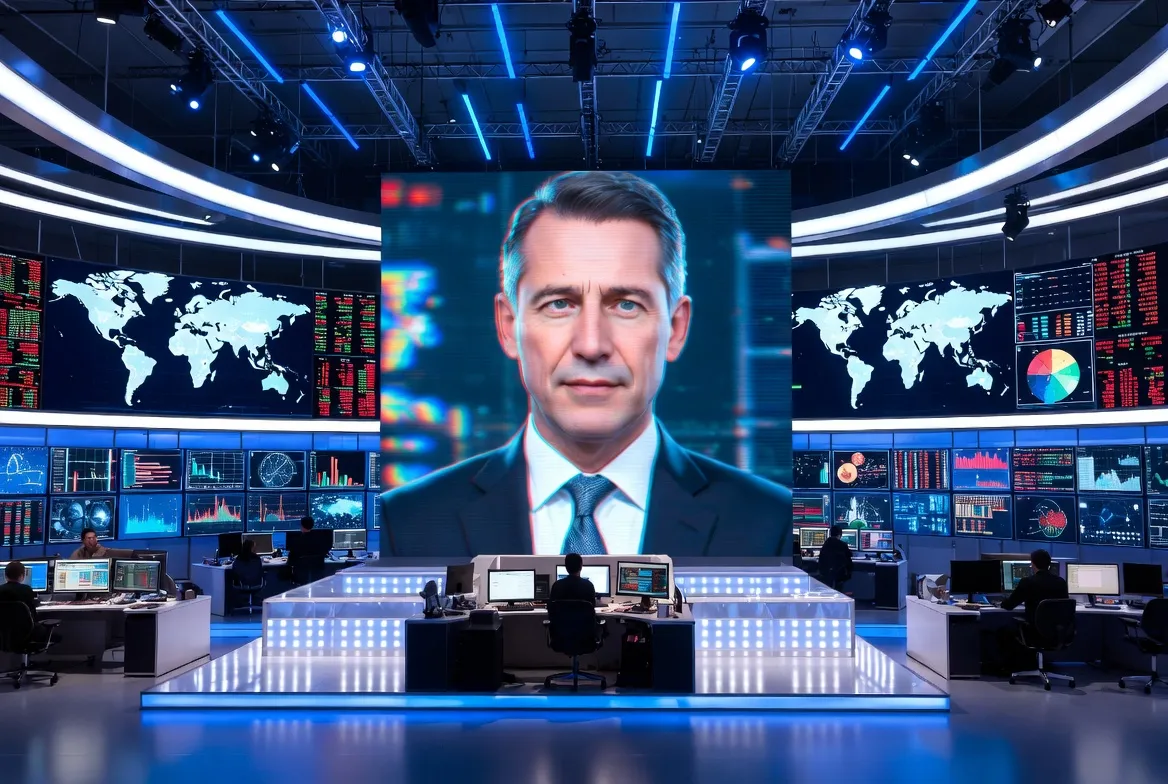
UK TV Introduces First AI News Presenter: What It Means for Journalism
 Himadri
In today’s times, a burning question is spreading like actual fire- How will AI actually overthrow humankind? Will we actually see an Ultron type rogue AI mind.? Well, a glimpse of that answer was revealed on October 20, 2025, by channel4.com of UK. The channel headlines topic read “Will AI take my job?”. It doesn’t sound different unless it’s realised, that the show was presented by … an AI host, AISHA GABAN
What was supposed to be a routine show, intended to investigate intrusion of AI into daily activities and occupation, turned upside down when the host itself turned out to be an AI. Yes, Gaban wasn’t human at all- irrespective of presence of intended trial, her face, expression, voice etc screamed its identity. This show raised a wave whose ripples still haven’t died. It raises questions on authenticity, trust and the present scenario of journalism. As we go through this blog, we will see more of this event that has added fuel to the long burning fire, public reactions and its associations with the parallel world market. Be attentive – both here, and hereafter. If an AI can judge its own intrusion, it’s going to be a Mission, impossible even for Ethan Hunt.
Aisha Gaban makes debut and steals the eyeballs
Picture this- An elegant professional, likewise dressed host woman, in an elegant studio, is talking about the extensive inclusion of AI in everyday occupations. Even not ending there, she proceeds to interview experts, visits places and asks intriguing questions, all with the perfection of a seasoned anchor. She guides the viewers in an hour long exploration and explanation video, through the challenges of AI inclusion as well as intrusion in sectors like medicine, law and creative sectors.
According to channel4.com, A program, designed with AI tools, tried and tested along call centers and designer offices – and concluded to be heavily capable to displace every literal office empty. What might be more intriguing, hence, is the origin of Ms. AI aka Aisa Gaban. It’s created by an AI fashion brand, Seraphinne Vallora in collaboration with production company Kalel Productions. She’s generated entirely through prompts fed into advanced AI systems.
No actors, no late-night shoots, no green screens – just programming. It’s noted that her mimicry of humane gestures touched heights – subtle tilt of head while emphasising, a warm smile etc. However, upon closer look, critics found her lips failing to sync to “s”, and eyes couldn’t be immune to regular AI made stuff, like mannequin- just there, no emotions, changes like humane ones. (theguardian.com)
Channel 4 press release, however, called it a historic moment in television history, called this Stunt revolutionising, in demonstration of AI deception.
The revelation of the deception was done in the final minutes. Gaban herself confessed: “My image and voice were generated using AI.” This statement was a mic drop moment that turned maybe a boring news watch into a heated debate. Channel 4, however, is not new in doing stuff like these. It’s renowned historically for pushing the boundaries of innovation. Louisa Compton, Channel 4‘s Head of News and Current Affairs, stated, “This stunt does serve as a useful reminder of just how disruptive AI has the potential to be—and how easy it is to hoodwink audiences with content they have no way of verifying.” It might be true, but its reception certainly wasn’t aligned. Amidst worries of the same thing happening in the near future, this stunt has made questions come up.
Hence, maybe intended as an entertaining way of delivering truth, they might have slapped it on people’s face through Aisha Gaban, and slapped it a bit too hard.
The Making: Crafting Aisha Gaban
How was Aisha Gaban built? The process of her making is said to be a long process of AI revolution, as per Channel 4. Kalel Productions is said to have utilised a set of advanced generative tools, that were trained on huge datasets of humane speech modules, facial expressions and footage of broadcast – all put together to create her persona.
“Create a confident British-Asian female anchor in her 30s, delivering news with empathy and authority” and similar prompts were fed into systems similar to that of Midjourney for visuals, and ElevenLabs for voice. It came out as a presenter capable of reading ad-lib, scripts, react to interviews and navigate virtual sets. Nick Parnes, CEO of Kalel, agreed to the irony of the event that he was at root of. He did agree that, utility of an AI presenter is cost effective. And with regular advancements of AI technology, the precision of models also keeps improving.
The cost saving thing isn’t untrue, not even an ounce. A human presenter deserves salaries, demands rehearsal, and needs to travel. AI works tirelessly all day long. Channel 4 made sure to adhere to community guidelines, including disclosing the fact of AI-being at the end, to avoid misleading the audience long term.
This transparency underscores a vital thought – AI works seamlessly, but journalism thrives on verification and authenticity. Adam Vandermark, Channel 4’s Commissioning Editor, posed his interrogative opinion on whether AI can completely replace a human presenter or not; it’s probably too early to conclude.
For those tech savvy minds, this might feel like an innovative inclusion, something that clarifies and strengthens AI’s role in media and communication. However, for others it might be an intrusion that blurs and threatens to erase the line between humans, natural and artificial.
Shock, Alarm: Public and Industry React
The social media went abuzz after the revelation. One user tweeted on X (Formerly Twitter): “Just watched Channel 4’s AI doc—thought the presenter was brilliant until the end. Mind blown. Terrifying.” Others confessed to missing the cues entirely. They claimed to watch the show yet not notice anything eerie or different. (messengernewspapers.co.uk)
Daily Mail called this “Black Mirror” Moment, in response to the event, and its “terrifying” response amidst users. Guardian reviewed it using terms like creepy and unsettling, particularly highlighting Gaban’s “dead eyes”.
Concerns didn’t end here. Krishnan Guru-Murthy, a Real life presenter voiced his concerns on reddit, pondering their roles’ non-clarity of lasting. AU data centers guzzle water and energy, and using an “AI presenter” By a channel intending to “Earn” people, looked like hypocrisy. UK actors’ union, Equity issued a Statement urging for the protection of jobs. Tech optimists praised it as innovative.
Viewer Sentiment Breakdown (based on early social scans)
- 45%: Shocked but intrigued—saw it as a clever awareness tool.
- 35%: Alarmed—feared job losses and deepfake proliferation.
- 15%: Skeptical—dismissed it as hype, unchanged in AI views.
- 5%: Amused—hailed Gaban as “the future we deserve.”
This mix highlights that society is optimistic of innovation and progress as well as in dread of obsolescence. Independent
This mix reflects broader societal divides: excitement for progress versus dread of obsolescence. Independent analysts stated that the stunt exposed a highly urgent need for ethical frameworks.
Influence on Journalism: Efficiency and Empathy
Journalism has always been a sacred place for everyone associated with it. It’s a sector that demands living experience and not making things up. It’s an endeavour that demands raw truth amidst crises. What Aisha Gaban was compelled to confront was, when powered by AU, journalism can scale that endeavor to great heights. It can present 24/7, in preference of the viewer, without the hassle of payroll. Gaban and her alikes can free human hands from deep dives and handle routine bulletin shows, in resource powered outlets. According to Channel 4, AI presenters can help cut costs equivalent to 70% of prevalent times, as per industry estimates. During Global crises, AI powered hosts can present non-stop, without accessibility limits. Proper algorithms can adjust tone – from tragedy based empathy to upbeat during breakthroughs. Early trials are said to have recorded a 20% surge in viewer retention.
However it has its demerits too. Authenticity is the pivotal script of journalism. As previously mentioned, Gaban’s dead eyes features puts a question on this very thing – can an inauthentic being, be an authentic presenter? The Guardian heavily criticised this highlight, noting that viewers have felt detachment.
The elephant in the room is Job Displacement. Analysts say, 75% of journalism tasks can be automated using prevalent AI tools, broadcasters are not immune.
Entry-level reporters, fact-checkers—poof, replaced by bots. Bias creeps in too: AI trained on skewed data could perpetuate stereotypes, as seen in early facial recognition fails.
Key Ethical Challenges:
- Transparency: making “AI-generated” watermarks necessary to counter deepfakes.
- Accountability: Facts stated in AI must be verified by humans.
- Diversity: Ensuring AI avatar voices don’t replicate known voices of humans.
- Regulation: The UK government must take things seriously.
A Global Perspective
The UK isn’t alone in this experimental followup. In 2018, China had its first ever AI presenter, Qiu Hai, who was inspired from real life Presenter Zhang Zhao. It was capable of 24/7 reporting via social media. It did highlight the efficiency of the State , but critics did call it propaganda amplification. (cnbc.com)
By 2024, The Guardian stated that China is deploying AI bots heavily to fabricate narratives, raising alarms of free speech.
Elsewhere, innovation varies:
- India and Indonesia: Virtual Anchors like Maya (India) present ground level local news, in dialects, aiming to engage with youth.
- Kuwait: Has a hijab wearing AI, Fedha, presenting Kuwait news, focusing on Cultural Sensitivity. (bbc.com)
- Mexico: NAT, Latin America’s pioneer, uses “soft news” to attract GenZ, showing AI’s power in lighter formats. (reutersinstitute.politics.ox.ac.uk)
- Greece and Taiwan: bots like Hermes take care of bullet point recaps, but it’s stated that audiences prefer humane “touch”. (euronews.com)
These cases highlight a pattern: AI can be very productive and cost effective in roles pre-designed and largely repetitive, but falters in connectivity and nuance. A 2023 PNAS study stated that AI shows are prone to human mistrust, hallucinations and false facts.
What the Future Holds?
Talking till 2030, AI presenters are likely to become norms. Deloitte forecasts state 40% inclusion in the forecast department, including automated transcription, or analytics driven by AI for spotting under covered beats. However, some organisations like Ofcom emphasize on inclusion of humans too, highlighting the high possibility of false information – turning journalists to tech savvy AI wranglers, looking after authenticity and ethics. Culturally, newsrooms must prepare to look after huge datasets to avoid echo chambers.
Channel 4 though, remains undeterred and continues to work after more experiments, as per Deadline, mostly working on AI powered debates and interviews.
Conclusion: Humane vs Human-made
Aisha Gaban may not appear on screens any time soon, but her picture stays fresh for a long. It’s an undeniable fact that AI is increasingly being amalgamated into our lives in a way we can’t avoid. In the context of journalism, it highlights some of the critical epithet’s characteristic – authenticity, resonance and humane touch. The path until now is- embrace innovation without giving up integrity.
Humanity, once considered irreplaceable, and still maybe so, is itself in crossroads with its own greatest creation. It’s us -do we dictate our made algorithms dictate lives or control them to amplify our stories. Anchor seats may change but the quest of the story, still humane. What’s your take – Game Changer, or Life Changer.? Share in the comments.
