
India’s AI Century: How Bharat Is Emerging as the Third Powerhouse in Global Artificial Intelligence
 Ayan Chakraborty
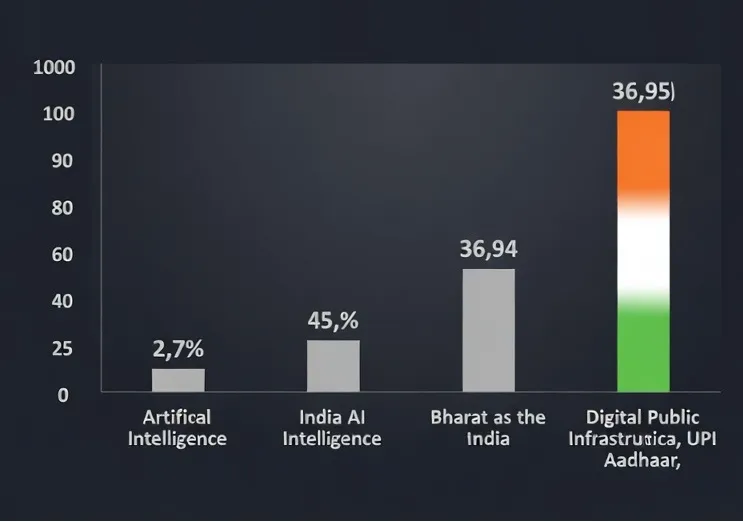
India’s AI is rapidly transforming from a promising sector into a global force, positioning Bharat as the third AI powerhouse after the United States and China. In 2026, with Stanford University’s Global AI Vibrancy Tool (2025 edition, based on 2024 data) ranking India third worldwide with a score of 21.59—behind the US (78.6) and China (36.95)—the nation has surged from seventh place in 2023. This leap reflects explosive growth in research output, talent acquisition, investments, infrastructure, and policy frameworks.
As AI reshapes economic strength, national security, defense capabilities, and civilizational identity in the 21st century, India’s empathetic and sovereign approach—rooted in “Make in India” and Atmanirbhar Bharat—stands out. From IT outsourcing roots to pioneering Digital Public Infrastructure (DPI) like Aadhaar, UPI, and Jan Dhan, Bharat leverages vast datasets and a young demographic to drive inclusive innovation. AI could add up to $1.7 trillion to India’s economy by 2035, boosting annual GDP growth by nearly 1.3%.
This ultimate guide explores how Bharat is emerging as an AI powerhouse in global artificial intelligence, examining historical foundations, government policies, key pillars, sectoral applications, challenges, unique model, and future outlook.
Historical Foundations: From IT Services to AI Innovation
India’s AI journey builds on decades as the world’s IT outsourcing hub. Since the 1990s software boom, companies like TCS, Infosys, and Wipro honed expertise in large-scale data processing, enterprise software, and system integration. These foundations provided the skilled workforce and process maturity essential for today’s AI scaling.
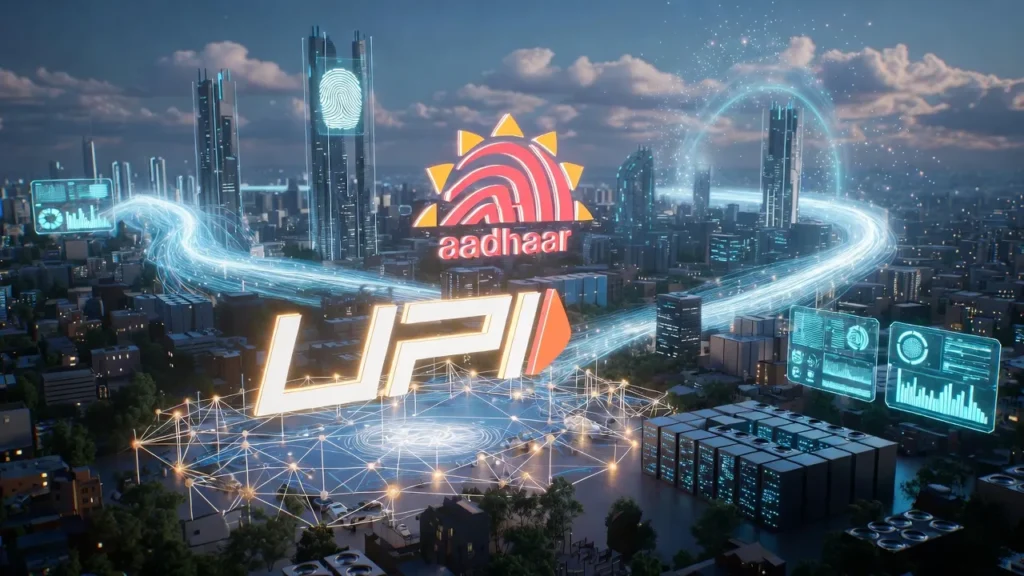
The real inflection came around 2010 with Digital Public Infrastructure (DPI) initiatives. Aadhaar created the world’s largest biometric ID system, Jan Dhan expanded financial inclusion, UPI revolutionized digital payments (now processing billions of transactions monthly), and Digital India broadened internet access. These systems generated massive, diverse datasets—rare outside China—that fuel AI models in governance, finance, healthcare, logistics, and more.
Internal Link Example: UK TV Introduces First AI News Presenter: What It Means for Journalism
In 2018, NITI Aayog released the National Strategy for Artificial Intelligence, framing AI explicitly for social good in areas like healthcare diagnostics, precision agriculture, education personalization, and smart mobility.
Post-COVID acceleration solidified AI’s role: contact tracing apps, vaccine distribution optimization, supply chain resilience, and automated credit scoring demonstrated practical value. By 2026, India’s ecosystem has matured from basic automation and RPA to applied intelligence, foundational models, and generative AI tailored for Indian languages and contexts.
Government-Led AI Architecture: Policy as a Force Multiplier
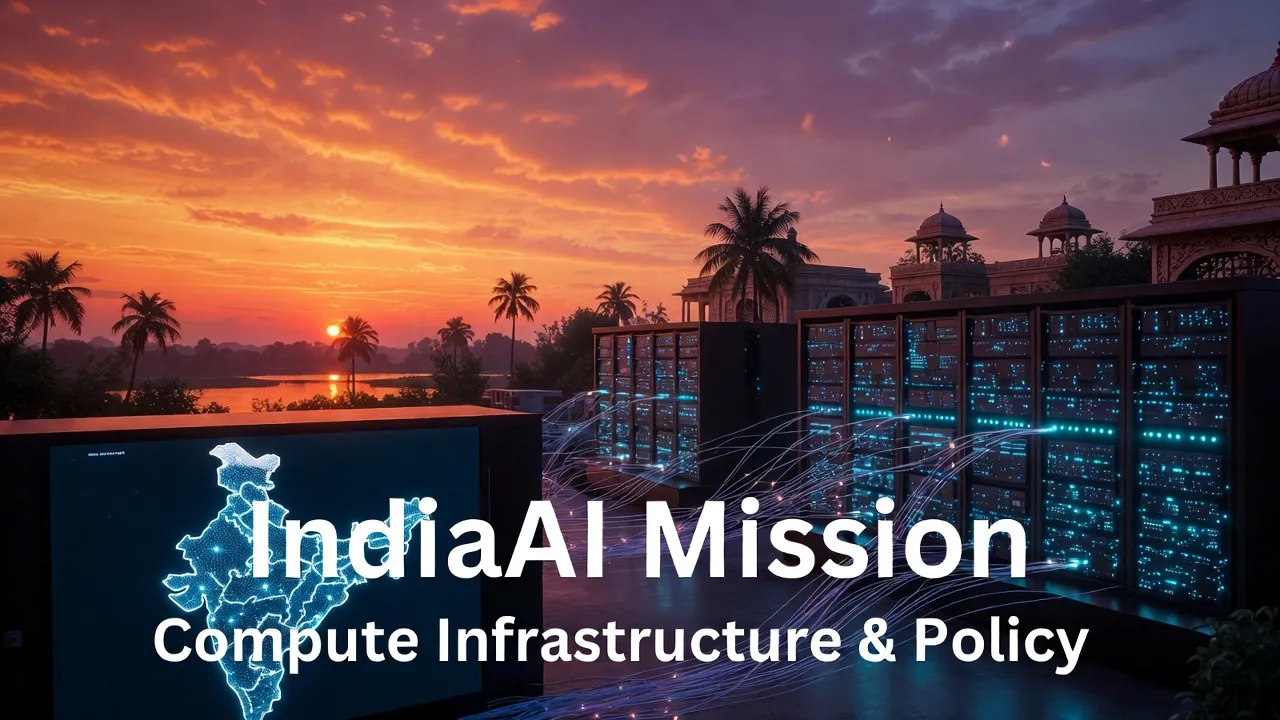
India’s rise stems from deliberate state intent. The IndiaAI Mission, approved by the Union Cabinet in March 2024 with an outlay of Rs 10,371.92 crore (~$1.25 billion), democratizes access to high-performance compute, quality datasets, indigenous models, skilling, startup funding, and responsible AI applications.
By early 2026, the mission has attracted around $70 billion in AI computing infrastructure investments. Discussions for IndiaAI Mission 2.0—with larger funding—are underway, focusing on scaling sovereign AI models and onshoring more workloads.
Key components include:
- Compute infrastructure: Shared GPU clusters and a national AI compute grid for startups and researchers.
- Data platform: Curated, anonymized public datasets with privacy safeguards.
- Indigenous models: Support for multilingual LLMs addressing India’s linguistic diversity (e.g., initiatives like Bhashini and Sarvam AI).
- Skilling: Training millions through platforms and university integrations (targeting 500+ universities).
- Innovation challenges: IndiaAI Innovation Challenge 2026 and application development initiatives for high-impact sectors.
Internal Link: Understanding Natural Language Processing (NLP) and Its Future
The Economic Survey 2025-26 advocates a phased approach: coordination and experimentation first, scaling second, regulation last—prioritizing innovation while building resilience.
November 2025 saw release of AI Governance Guidelines: Enabling Safe and Trusted AI Innovation, emphasizing ethical deployment, risk management, and public procurement safeguards.
These policies position India’s AI not just as competitive but as a tool for Viksit Bharat @2047—equitable, inclusive growth.
Caption: IndiaAI Mission accelerating sovereign compute and innovation.
Key Pillars Supporting Bharat’s Emergence as an AI Powerhouse
India’s AI vibrancy rests on robust pillars, as captured in Stanford’s index (research & development, talent, infrastructure, policy & governance, economy, etc.).
Talent Pool: India boasts one of the world’s largest digitally skilled workforces. By 2025, the AI talent pool reached approximately 416,000 professionals, with hiring rates leading globally (~33% annual acquisition). The pool is projected to more than double by 2027 at ~15% CAGR. NASSCOM estimates capacity to reskill 8-10 million in AI-related areas by 2030. India ranks high in AI skill penetration and contributes significantly to global AI talent supply.
- Over 6 million tech/AI-related jobs supported.
- Strong STEM output from IITs, IISc, IIITs, and growing private institutions.
- Programs like FutureSkills Prime and mission-linked university modules.
Startups and Investments: India ranks among top globally for new AI companies funded. In 2025, AI startups raised over $643 million (early and growth stages dominant), with total startup funding nearing $11 billion. Ecosystem features application-focused innovators.
Notable players:
- Sarvam AI: Building India-first multimodal LLMs for Indian languages.
- Krutrim (Ola): Sovereign foundational models.
- Fractal Analytics: Enterprise AI analytics.
- Arya.ai: Deep learning for BFSI and healthcare.
- Mad Street Den (Vue.ai): Retail computer vision.
- Locus: AI logistics optimization.
- Established IT giants (TCS, Infosys, Wipro) investing heavily in AI suites like Infosys Topaz and Wipro’s $1B workforce AI training.
Research and Innovation: Rising research output, innovation index strength, and open-source contributions. Support via Research Development and Innovation Scheme funds ($12B across emerging tech).
Infrastructure: DPI + expanding data centers, cloud (Microsoft $17.5B, Google $15B commitments), and mission-backed compute. Tech sector revenue projected to cross $280B in 2026.
India’s AI emphasizes real-world, inclusive deployment:
- Healthcare: AI diagnostics (e.g., retinal scans, TB detection via DPI-linked systems), personalized medicine, rural telemedicine.
- Agriculture: Precision farming, crop monitoring via satellite/drone AI, yield prediction—critical for food security.
- Finance: UPI fraud detection, credit scoring for underserved populations, algorithmic trading.
- Governance & Logistics: Smart cities, supply chain optimization, e-governance chatbots in regional languages.
- Defense & Security: Autonomous systems, cybersecurity AI, surveillance analytics (with ethical safeguards).
- Education: Adaptive learning platforms overcoming language/literacy barriers.
Over 200 specialized AI solutions developed by Indian firms for high-impact sectors, many showcased at events like the India AI Impact Summit 2026 (Feb 2026, New Delhi).
Internal Link: Dive deeper into sectoral use cases in AI Applications Transforming Indian Industries.
Challenges on the Horizon for India’s AI Journey
Despite momentum, hurdles remain:
- Talent supply-demand gap (~50% shortage in specialized roles).
- Compute access and energy costs for large models.
- Data quality, privacy (DPDP Act implementation), and bias in diverse contexts.
- Geopolitical dependencies on foreign chips/semiconductors.
- Ethical risks, deepfakes, job displacement—addressed via phased governance.
- Scaling indigenous foundational models competitively.
The Economic Survey emphasizes coordination first and resilient supply chains.
India’s Empathetic and Sovereign AI Model: A Blueprint for the Global South
India’s strategy prioritizes social good, multilingual inclusivity, open-source collaboration, and data sovereignty—differing from purely commercial models elsewhere. Voice-first interfaces, low-resource language support, and DPI-inspired public-good focus offer lessons for emerging economies. Initiatives like IndiaAI promote responsible innovation aligned with cultural and developmental needs.
Internal Link: Compare approaches in Sovereign AI Strategies: India vs Global Leaders.
Future Outlook: Towards Viksit Bharat and Global Leadership
By 2030, India’s AI market could reach $126B; by 2035, substantial GDP contribution. IndiaAI Mission 2.0, expanded compute, AI-OS/code repositories, and global summits like India AI Impact Summit 2026 will accelerate progress. Focus on open models, public-private partnerships, and Global South leadership positions Bharat to shape ethical AI norms.
With continued execution, India’s AI century will deliver economic transformation, national resilience, and inclusive prosperity.
Conclusion
India’s AI century marks a historical shift: from back-office IT provider to co-shaper of global artificial intelligence. Backed by policy intent, talent scale, DPI assets, and an empathetic sovereign vision, Bharat is emerging as the third AI powerhouse. While challenges persist, the trajectory signals profound impact on the Global South and beyond. Staying user-first—focusing on deployment, ethics, and accessibility—will define success.
