
 Himadri
 Two years ago, when the big language models first hit the public. Yes, I am talking about AI. Everyone knows about it. The entire SEO community panicked. Including me, everyone thought that blogging was going entirely dead. Thousands of completely automated articles were generated overnight. I also wanted to take advantage of the system and make money via AdSense. But what about today’s search engine results pages?
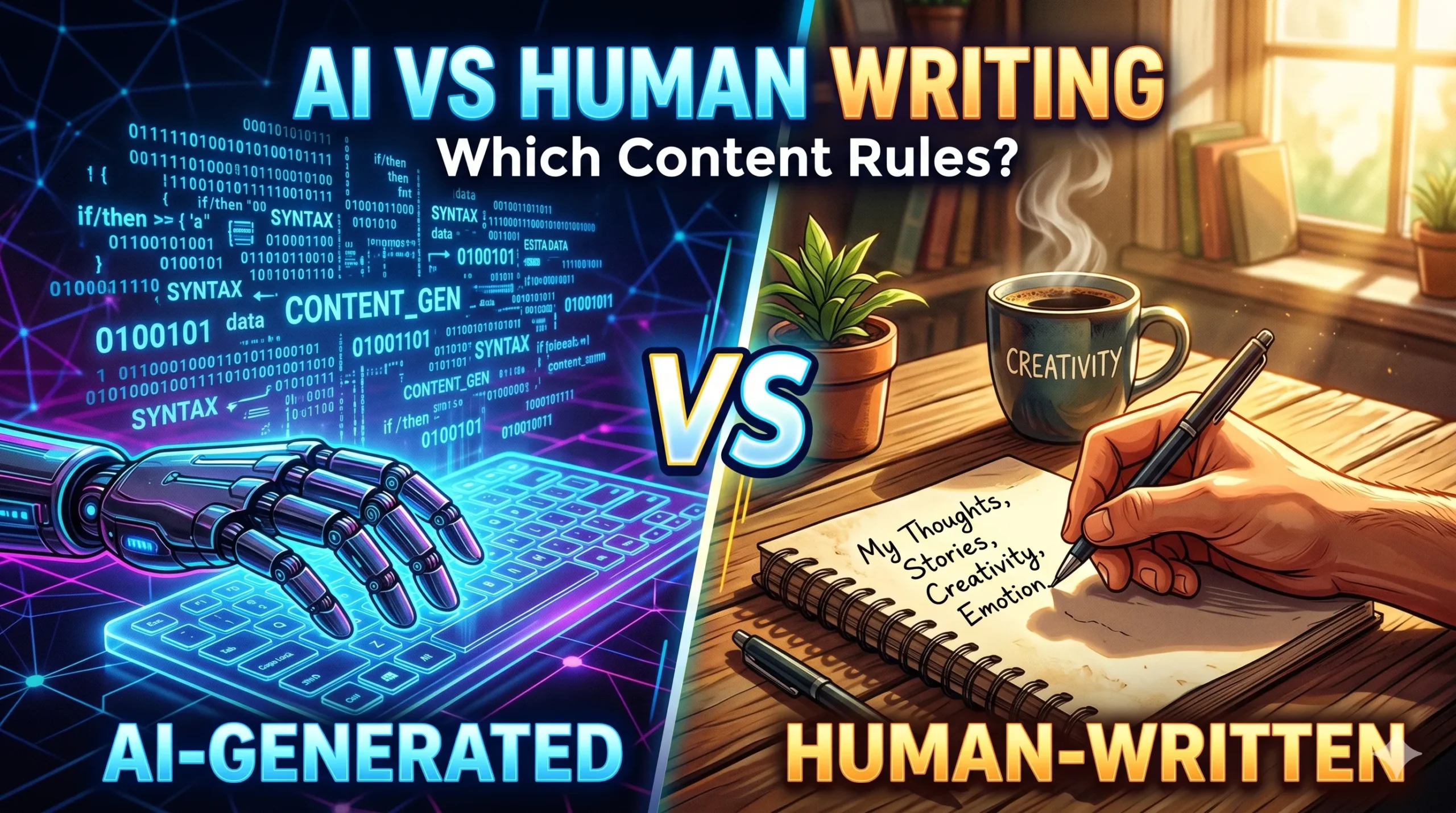
It’s all over now. Furthermore, who created the material is no longer the main point of contention between AI and human content. It all depends on how it is read. If you’re trying to rank a website now and get an AdSense account approved right now, you need to understand the exact mathematical differences between robotic text and a genuine human accent.
The “Eye Test”: Why Most AI Fails Instantly
You don’t even need a fancy software tool to spot bad AI writing. Your brain automatically flags it. Think about the last generic article you read. Did it start with “In today’s fast-paced digital landscape…“ or “In the age of the 21st century…“? Did it use the word “delve” or call something a “rich tapestry“? Did every single paragraph start with “Furthermore” or “In conclusion”?
That is the hallmark of lazy automation. Large language models are trained to be as safe, polite, and grammatically flawless as physically possible. They lack opinions. They don’t have personal anecdotes about how a piece of software crashed on them at 3 AM. They just spit out the most statistically probable sequence of words. To a human reader, that perfect, flawless grammar actually comes across as deeply boring and untrustworthy.
The Math Behind the Curtain: Perplexity and Burstiness
If you want to know how strict tools like Originality.ai or Turnitin catch AI, you have to look under the hood. They don’t just look for buzzwords. They measure the math of your sentences.
| The Metric | What It Actually Means | Who Wins? |
|---|---|---|
| Perplexity | How predictable the word choices are. AI always picks the most logical next word. Humans use weird slang and unexpected synonyms. | Human writing has much higher perplexity. |
| Burstiness | The variance in your sentence lengths. AI loves writing paragraphs where every sentence is exactly 15 words long. | Humans are erratic. We write punchy fragments. Then we follow them up with massively long run-on sentences. |
If you run a standard ChatGPT output through a detector, it lights up red because the perplexity and burstiness are mathematically flatlined. It’s too uniform. To beat the detectors, you essentially have to force the text to be a little bit messier and a lot more unpredictable.
Google’s Official Stance (The AdSense Reality Check)
Here is the elephant in the room. Will Google ban you just for using AI?
The answer is “No, never”. Google’s official Search Central guidelines are actually surprisingly clear on this. They do not penalise content strictly for being AI-generated. What they brutally penalise is *spam*. If you use an AI to regurgitate the exact same Wikipedia facts that are already on ten thousand other websites, you are going to get hit with a “thin content” penalty, and your AdSense application will get rejected instantly.
Google ranks content based on E-E-A-T: Experience, Expertise, Authoritativeness, and Trustworthiness.
An AI cannot have first-hand experience. It has never actually used a mechanical keyboard, driven a Tesla, or tested a camping tent in the rain. That is where the human element is entirely non-negotiable. Here SEO comes.

What is SEO?
SEO stands for ‘Search Engine Optimisation’. In the simplest terms, it is the process of making your website look as attractive and helpful as possible to search engines (like Google, Bing, or Yahoo) so that they put your website at the very top of the search results when someone looks for a topic.
Imagine you open the greatest bakery shop. You have the best cookies, the best cakes, and the friendliest staff. But there is a huge problem. You built your bakery in the middle of a dense forest where there are no roads, no streetlights, and no signs. No matter how amazing your cookies are, you will go out of business because nobody can find you. SEO is how you build the roads and the signs to your bakery.
So, when marketers talk about doing SEO, they are just talking about tweaking their website’s words, speed, and popularity so that Google’s algorithm says, “This is the best bakery; let’s put it on Main Street where everyone can see it!”
Conclusions:
At the end of the day, you can absolutely use AI to outline your articles, fix your grammar, or brainstorm ideas. But the second you let a machine hit “publish” for you without injecting your own messy, real-world experience? You lose. Google’s algorithm is entirely built to reward the bakeries that put up the brightest neon signs and bake the most authentic cookies.
So stop worrying about whether a machine generated a specific sentence. Start worrying about whether a real human being actually wants to read it. Build the roads and share your experiences, and the search rankings will follow.
